Blog
Skytec Partners with Trutta Environmental Solutions to Create Comprehensive Hydrographic Survey Tools
Combination of bathymetry and LiDAR provides in-depth data and view of stream quality for aquatic resource managers in Tennessee.
Since its inception in 2015, Skytec has created data-driven solutions to meet clients’ geospatial mapping needs. Environmental work is a major component of Skytec’s offerings, providing a high level of data and detail for clients in land and natural resource management, mitigation projects, environmental stewardship projects, floodplain mapping for municipalities, and more.
With robust data capture abilities through unmanned aerial systems (UAS) and remote satellite monitoring with Planet, paired with the company’s ESRI silver partner certification and experience, Skytec delivers a full spectrum of mapping and analysis tools to drive sound decision-making for clients. But how could Skytec’s services be leveraged to capture and complement hydrographic data?
Co-founder and CTO Andy Carroll at Skytec partnered with Trutta Environmental Solutions recently to capture LiDAR data as part of Trutta’s High Definition Stream Surveys.
Trutta Environmental Solutions, LLC is an SBA-certified Women Owned Small Business focused on serving the water resources and fisheries communities. The Trutta team developed the High Definition Stream Survey (HDSS) method, a peer-reviewed technique that integrates cutting-edge technology to make stream and river data collection faster, less expensive and more thorough than traditional collection methods.
What is HDSS?
HDSS method provides water managers with an integrated suite of stream corridor information to support effective decision-making. By employing advances in automation and technology, HDSS enables the continuous collection of geo-referenced imagery with instream, streambank, water quality, and bathymetric data over long reaches. HDSS delivers to managers and stakeholders more data, faster, and at lower cost as compared to traditional methods.
As a result, the HDSS platform transforms featureless blue lines on a map into data-rich, 1-meter resolution GIS layers representing numerous instream and streambank parameters. These parameters can be combined in informative ways to create powerful decision-support tools allowing for a new holistic approach to river and stream management.
Bathymetry and LiDAR: A Collaborative Process
As part of HDSS, the Trutta team collects bathymetric data, or the measurement of depth in bodies of water. When resource managers along the Duck River in Tennessee sought hydrographic mapping data to analyze a potential drinking water intake location, they turned to Trutta. Trutta Hydrologist and Director of Sales Brett Connell consulted with Carroll and Skytec to innovate an effective method to capture shoreline data.
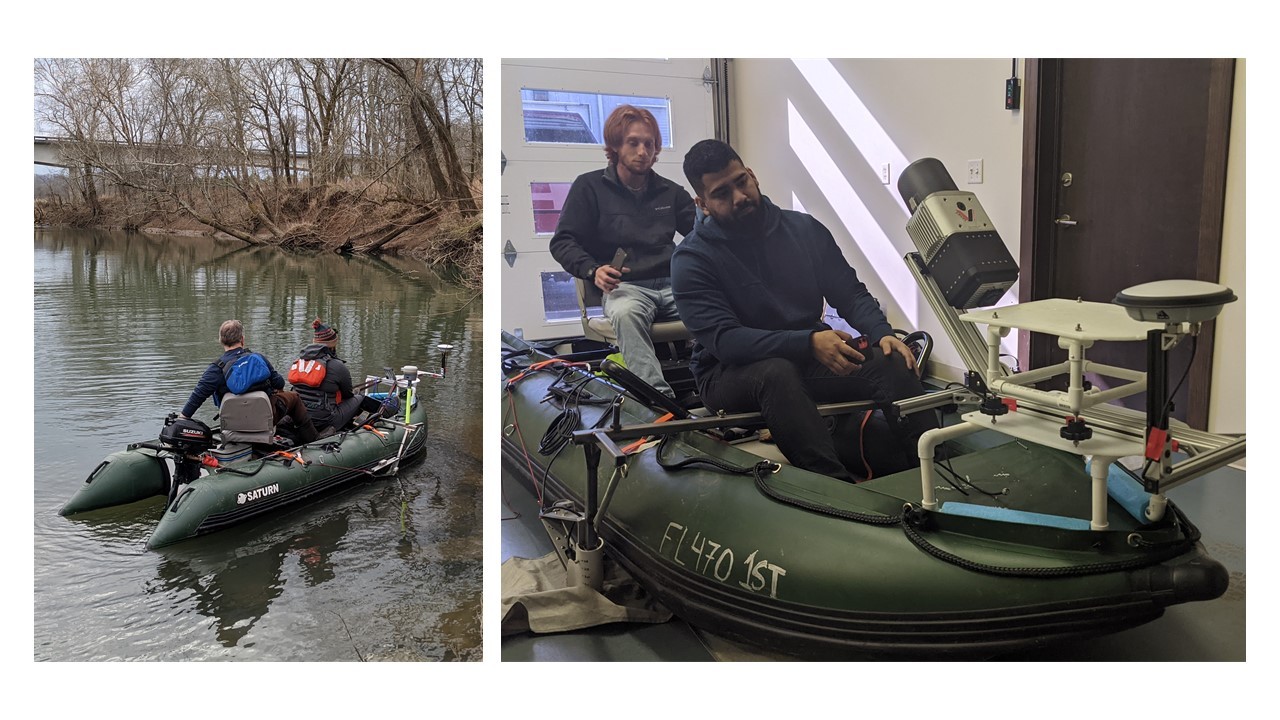
Typically, Trutta uses high-definition video and imagery to capture data; however, this project presented unique challenges. The Trutta team needed specific terrestrial data points to complement the bathymetric data. Given the job site’s particular location, UAS wasn’t an option for this project. Together, Connell and the Skytec team rigged Skytec’s LiDAR sensor to one of Trutta’s boats for mapping, instead.
“This type of project really enabled us to drive innovative solutions for a client,” Carroll says. “The Trutta team typically builds custom rigs for sensors, and this was no different. Brett and our team built a custom platform for the boat to safely and securely mount the LiDAR scanner we typically fly. The results were spot on.”
Novel Solutions for Clients
Trutta operates kayaks and 13-foot inflatable boats; the inflatable boats are nimble and enable operators like Connell to maneuver easily in shallow water. By mounting LiDAR on the 13-foot boat, Trutta and Skytec captured both bathymetric and terrestrial data that was combined on the back end for a more complete, efficient analysis for the client.
“We typically create assessments from video capture,” Connell says. “By using LiDAR as part of our system, we were able to more efficiently capture and model that data and extract usable information for our client.”
Similarly, Carroll says the Skytec team was able to leverage its partnership with ESRI to provide 3D modeling components and create robust products to fit the client’s specific needs.
“This was a unique project given the constraints,” Caroll says. “Trutta’s project runs parallel with our use of geospatial data—namely, engineering and design work—that made us a strong collaborator on this type of project.”
Both Carroll and Connell agree this novel solution for clients presents both team’s combined strengths and skills.
“This type of work is at the forefront of what we do—providing affordable hydrographic surveys,” Connell says. “To be able to combine that with Skytec’s LiDAR and terrestrial data shows great potential for ground we can cover for clients.”
Read more about Skytec’s acquisition tools or contact us to get started today.
Read more about Trutta’s High Definition Stream Survey or contact us to get started today.
Skytec Blog
Leveraging the Latest Geospatial Technologies to Advance Wetland Identification
Launching Skytec’s Wetland Screening Tool for the State of Tennessee
Read More
Using GIS to Lead in Sustainable Supply Chain Management
At Skytec, we’re proud to partner with industry leaders like International Paper to develop innovative, GIS-based solutions that address complex challenges in sustainable sourcing and supply chain management.
Read More
Skytec Delivers Macro- to Micro-Level Data to Support Decision-Making and Planning in Architecture, Engineering & Construction
Skytec’s expertise supports architecture, engineering, and construction (AEC) firms in evaluating and monitoring development sites from conception to completion.
Read More